Newspaper
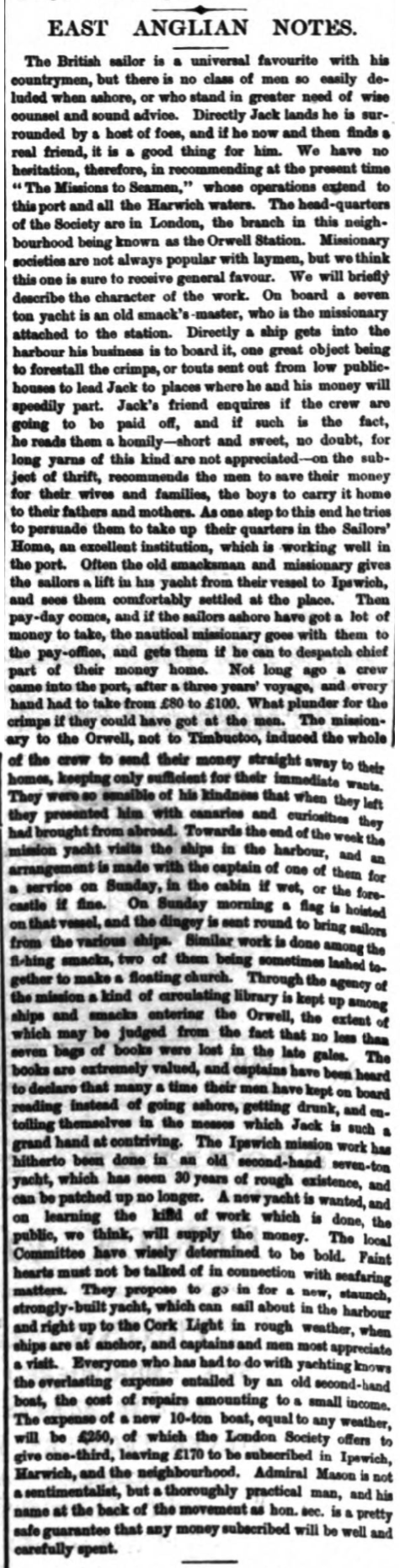
About this newspaper cutting
A newspaper cutting, dated 15 Dec 1880.
Thomas Pechell is mentioned: “East Anglian Notes” in East Anglian Daily Times.
It is held by British Newspaper Archive.
What it says
EAST ANGLIAN NOTES.
The British sailor is a universal favourite with his
countrymen, but there is no class of men so easily de-
luded when ashore, or who stand in greater need of wise
counsel and sound advice. Directly Jack lands he is sur-
rounded by a host of foes, and if he now and then finds a
real friend, it is a good thing for him. We have no
hesitation, therefore, in recommending at the present time
"The Missions to Seamen," whose operations extend to
this port and all the Harwich waters. The head-quarters
of the Society are in London, the branch in this neigh-
bourhood being known as the Orwell Station. Missionary
societies are not always popular with laymen, but we think
this one is sure to receive general favour. We will briefly
describe the character of the work. On board a seven
ton yacht is an old smack's-master, who is the missionary
attached to the station. Directly a ship gets into the
harbour his business is to board it, one great object being
to forestall the crimps, or touts sent out from low public-
houses to lead Jack to places where he and his money will
speedily part. Jack's friend enquires if the crew are
going to be paid off, and if such is the fact,
he reads them a homily—short and sweet, no doubt, for
long yarns of this kind are not appreciated—on the sub-
ject of thrift, recommends the men to save their money
for their wives and families, the boys to carry it home
to their fathers and mothers. As one step to this end he tries
to persuade them to take up their quarters in the Sailors'
Home, an excellent institution, which is working well in
the port. Often the old smacksman and missionary gives
the sailors a lift in his yacht from their vessel to Ipswich,
and sees them comfortably settled at the place. Then
pay-day comes, and if the sailors ashore have got a lot of
money to take, the nautical missionary goes with them to
the pay-office, and gets them if he can to despatch chief
part of their money home. Not long ago a crew
came into the port, after a three years' voyage, and every
hand had to take from £80 to £100. What plunder for the
crimps if they could have got at the men. The mission-
ary to the Orwell, not to Timbuctoo, induced the whole
of the crew to send their money straight away to their
homes, keeping only sufficient for their immediate wants.
They were so sensible of his kindness that when they left
they presented him with canaries and curiosities they
had brought from abroad. Towards the end of the week the
mission yacht visits the ships in the harbour, and an
arrangement is made with the captain of one of them for
a service on Sunday, in the cabin if wet, or the fore-
castle if fine. On Sunday morning a flag is hoisted
on that vessel, and the dingey is sent round to bring sailors
from the various ships. Similar work is done among the
fishing smacks, two of them being sometimes lashed to-
gether to make a floating church. Through the agency of
the mission a kind of circulating library is kept up among
ships and smacks entering the Orwell, the extent of
which may be judged from the fact that no less than
seven bags of books were lost in the late gales. The
books are extremely valued, and captains have been heard
to declare that many a time their men have kept on board
reading instead of going ashore, getting drunk, and en-
[tangling?] themselves in the messes which Jack is such a
grand hand at contriving. The Ipswich mission work has
hitherto been done in an old second-hand seven-ton
yacht, which has seen 30 years of rough existence, and
can be patched up no longer. A new yacht is wanted, and
on learning the kind of work which is done, the
public, we think, will supply the money. The local
Committee have wisely determined to be bold. Faint
hearts must not be talked of in connection with seafaring
matters. They propose to go in for a new, staunch,
strongly-built yacht, which can sail about in the harbour
and right up to the Cork Light in rough weather, when
ships are at anchor, and captains and men most appreciate
a visit. Everyone who has had to do with yachting knows
the everlasting expense entailed by an old second-hand
boat, the cost of repairs amounting to a small income.
The expense of a new 10-ton boat, equal to any weather,
will be £250, of which the London Society offers to
give one-third, leaving £170 to be subscribed in Ipswich,
Harwich, and the neighbourhood. Admiral Mason is not
a sentimentalist, but a thoroughly practical man, and his
name at the back of the movement as hon. sec. is a pretty
safe guarantee that any money subscribed will be well and
carefully spent.